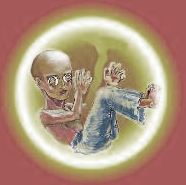
In2
Remark: The link In2 is a Quicktime movie of about 4.1MB. It can be viewed with open source viewers such as e.g. Xine.
About In2:
In2 is a looped video/movie which shows a "mathematically distorted zoom" into an infinitly dense painted, itself repeating picture. Artistically the self-deforming comic type painting of a humanoid serves as a more or less ironic comment on issues such as self-conception, self-concentration, identity search a.s.o. It may belong to the species of Reflexive Alloselves :-)(see Marcos Novak).
Technically I would like to call In2 a "moving still" and that's why:
-
In2 is given by a pairing of a
painting (i.e the still) on one hand and a
family of
mathematical transformations, which act on the painting as deformations,
one the other hand. The deformations as well as the paintings are
mutually inspired. In the sequel I won't comment on the artistic content
of this pairing, but on this construction.
The mathematical transformations can be e.g. "realized" by a certain deformation of the image in time (i.e. a movement). This can be compared to a "zoom" in a movie. (Likewise one could "realize "these transformations e.g. by a deformation via a slider in a Java applet.)
That means: By making a choice for the realization (i.e. for example by choosing the velocity of a "zoom"), one determines the APPEARANCE of In2.
Moreoever: given an appearance for In2 this choice COULD be altered in a determined way (e.g. choose another "zoom" velocity), as one knows about the original construction of the still and its possible deformations.
And even more - having the information about the possible deformations one could do completely without the "zoom", but instead choose only a small set of specific stills (may be even only one still) as representatives for the still and its deformations.
Choosing one specific representative is comparable to choosing to paint a scene from one specific viewpoint. The difference to a moving still is that the painter of a painting (in contrast to the moving still) usually doesn't let the spectator know the set out of which the choice was made.
A similar thing happens in movie making. Here one usually rather avoids explicit zooms, but replaces them with cuts. This is possible as everybody understands this "choice of representatives". Everybody knows that if one sees first a long shot and then a close up (the two representatives) then there lies a family of scaling transformations in between (i.e. a "coming closer" or "zoom"). And so - instead of showing the whole zoom - it is enough to show the two stills around the gap left by the cut. However it is only SOMEWHAT clear how this "zoom" could have looked like. And the "somewhat" is actually crucial to the movie. In a moving still the "zoom" is may be hidden inside a mathematical formula, but it is precise and can be recovered.
Moreover in the case of In2 the described "guessing" of the "zoom", as in the case for the movie, would not work as well, as here the "zoom" is not coming from an everyday experience. It is a distorted "zoom". It is described by mathematics and is called a family of transformations. Nevertheless one COULD still choose two stills as representatives - just as in a movie. One could even choose just one still. And actually this is what M.C. Escher (may be unknowingly?) did in his drawing "The Picture Gallery".
In the project Escher and the Droste Effect at the University Leiden mathematicians were "filling in the gap" in order to give a better understanding of the mathematical transformations connected with this drawing. Looking at their work one can see that it is possible to interprete Eschers work as a still from a (twisted) zoom. So the picture gallery is also a "moving still".
I was inspired by the work of Escher and the group in Leiden. For In2 I used the zoom-droste-part of their work but did not do the "twisting". Instead of the "twisting" I "distorted" the zoom in order to get the insideout feeling. (For more on that see technical and mathematical description).
In2 is conceptionally similar to the
the follow-up project InU2.
Technical description:
In2 makes use of the following fact:In a central perspective (or one point perspective) the principal point is the projection of the point of sight upon the plane of the image. Consequently - if one zooms into a central perspective in a way that the principal point is kept fixed (which is the same as a radial scaling) then this appears as a a walk into the "missing" third dimension of the two dimensional canvas (i.e. a change of viewpoint).
Among others this fact was beautifully used in the project at the University of Leiden , where a "twisted scaling" was used to simulate a walk into the "missing" third dimension of a (twisted) cityscape drawn by M. C. Escher.
Furthermore an image displays the socalled "Droste effect" (or Matryoshka effect) if one draws the image in such a way that the scaling by a certain factor gives back the original image. The picture of Escher, which was used in the project at Leiden University displayed the Droste effect (for the "twisted scaling").
In In2 different mathematical transformations as in the project in Leiden/in Escher's picture are used, nevertheless the transformations are mathematically connected.
In In2 a somewhat "distorted scaling" (hyperbolic transformation) is used for a walk into a humanoid. Here the observer zooms INTO the left eye of the displayed humanoid and zooms OUT OF the right eye. After the "distorted scaling" by a certain factor the original image is again restored, i.e. the Droste effect had also been implemented.
Mathematical description:
The transformations are hyperbolic transformations, i.e. certain types of Moebius transformations (Cf. e.g. Dubrovin, Fomenko, Novikov "Modern Geometry" Part II for details). The two fix points of the hyperbolic transformations are the same for all transformations applied to the image (as a domain in C). They are in the eyes of the humanoid.The Droste effect is constructed similarily as in the project at Leiden. Just conjugate (in terms of composition of maps) the family of scaling transformations (scaling is a special Moebius transformation) with a Moebius transformation which maps the zoom-in fix point to zero and the zoom-out one to infinity. (remark: In In2 the point between the eyes is mapped to one - this fixes the conjugating transformation)
Note: There is no adjusted rotation in the universal covering ("twisting") like in the Leiden project (for more details please refer to their very nice mathematical description in the Notices of the AMS Volume 50, Nr. 4, April 2003). Acknowledgements: Thanks to Tim for the help with the Java programming!
© Nadja Kutz, July 2004
In2 was featured by Doron Golan on DVBlog.org on August 15, 2005.